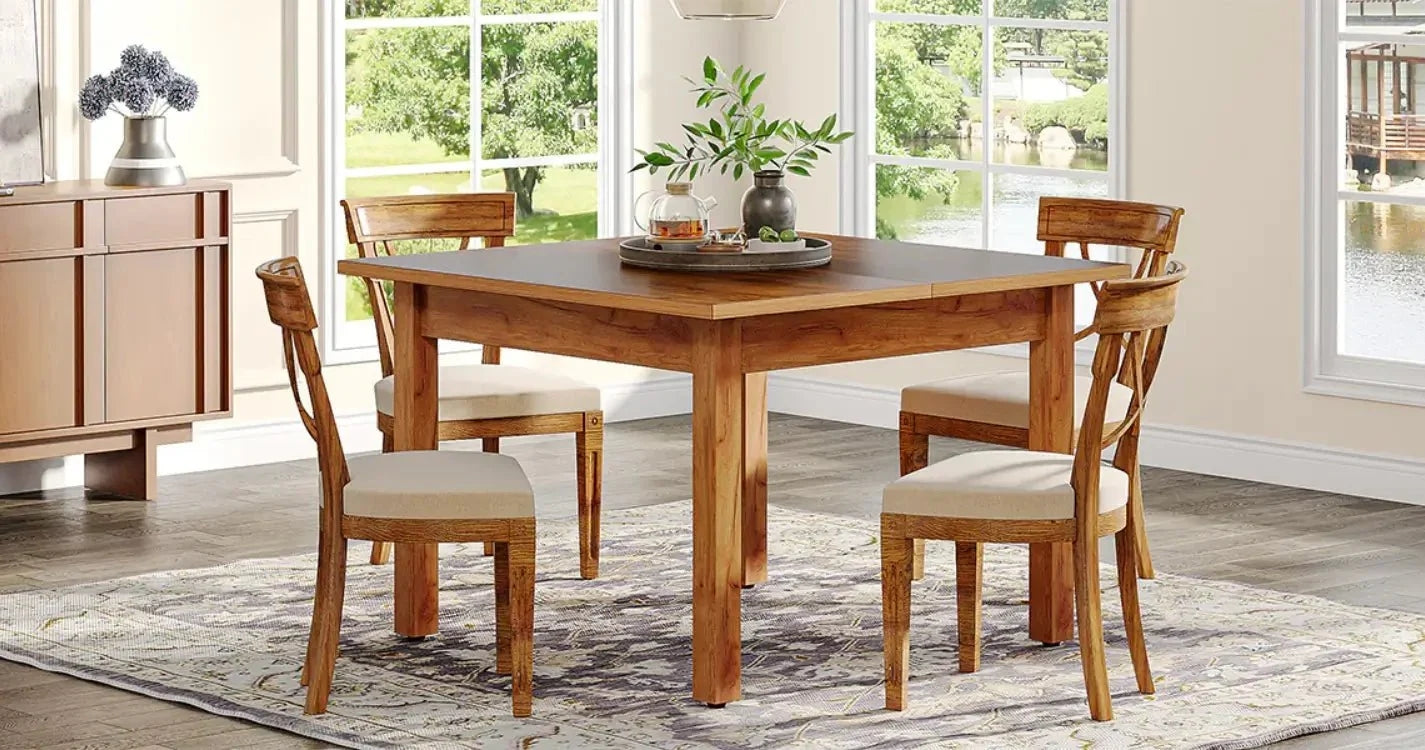

A pedestal dining table is a practical option for flexible seating, round dining tables and compact dining areas. In most homes, the choice depends on how the table will be used: a pedestal table tends to feel easier for casual seating, while a four-leg dining table often feels more dependable for family meals, homework, working from home and everyday activity.
Quick Comparison
|
Factor |
Pedestal Dining Table |
Four-Leg Dining Table |
|
Best for |
Round tables, small dining areas, flexible seating |
Rectangular tables, family dining, larger table tops |
|
Legroom |
Usually more open around the edges |
Corner legs may limit chair placement |
|
Stability |
Depends heavily on base size and weight |
Usually more stable by design |
|
Seating flexibility |
Easier to add an extra chair |
More limited by leg position |
|
Style |
Softer, cleaner, more sculptural |
Classic, familiar, versatile |
|
Everyday family use |
Good if the base is sturdy |
Usually better for heavy daily use |
|
Small-space comfort |
Feels visually lighter |
Can work well, but leg placement matters |
|
Best table shapes |
Round, oval, smaller square |
Rectangular, square, larger round tables |
What Is a Pedestal Dining Table?
A pedestal dining table stands on a central base rather than four corner legs. This structural choice changes how the table feels in use: chairs can move more freely around the edge, and a round or oval table top often feels more open and balanced.
For this style, we suggest the Tribesigns farmhouse round dining table with cross base, from £155.99.

Its appeal is not that it automatically takes up less floor space. The advantage is that fewer legs interrupt the seating area. In a breakfast area, a flat dining corner or an open-plan kitchen, this can make the table easier to approach and less visually heavy.
The base itself is the main point to check. A wide, weighted pedestal can feel solid, while a slim base under a large top may feel less secure. With pedestal dining tables, the design of the base matters as much as the shape of the table top.
What Is a Four-Leg Dining Table?
A four-leg dining table has a support point near each corner of the table top. It is a familiar structure, but its strength is practical: the weight is spread out, so the table usually feels steadier under daily use.
This matters most with larger, heavier or rectangular table tops. A four-leg dining table is often the more dependable choice for family meals, homework, working from home and anything else that turns the dining table into a shared household surface.
The trade-off is seating flexibility. Corner legs can determine where chairs fit comfortably and where they do not. In a tight room, this can make the layout feel more fixed; in a larger room, it is usually less of an issue.

Seating and Legroom
A pedestal dining table gives chairs more room to move because there are no corner legs setting the seating positions. This is especially useful with round or oval dining tables, where people sit around the full edge instead of lining up along fixed sides.
The catch is underneath. A bulky pedestal can still block feet or chair legs if it spreads too far outwards.
Stability
Four-leg dining tables usually feel steadier because the support is spread towards the corners. That makes them a better fit for long rectangular dining tables, heavy table tops such as a sintered stone top dining table, and dining tables that handle daily family use.
A pedestal dining table can still be stable, but proportion matters more. A wide, weighted base under a moderate-size top can feel solid; a slim base under a large top may feel less secure.
For casual meals, a well-built pedestal dining table can work well. For homework, laptops, crafts, children and constant movement, four legs usually offer more confidence.
Small Dining Spaces
A pedestal dining table does not actually make the table top smaller. A 48-inch round dining table still takes up a 48-inch circle, no matter what base it uses.
What changes is how easily the chairs move. Without corner legs, chairs are easier to pull out, push in and adjust in a tight room. That can make a compact dining area feel more usable.
A four-leg dining table can still work in a small dining room if the legs are slim and well placed. The issue appears when the legs compete with the chairs.
Before buying, mark the table top size on the floor and test it with chairs. If people can sit, stand and walk around comfortably, the layout works.
Style
Style should not be the only factor, but it does matter. A dining table is often one of the largest pieces in a room.
Pedestal dining tables tend to look softer and more sculptural. They work especially well when the room needs a visual focal point without too many legs or hard lines. Round pedestal dining tables can make a dining area feel more conversational and relaxed.
Four-leg dining tables feel more classic. They fit easily into farmhouse, rustic, traditional, industrial and modern dining rooms. A simple four-leg dining table rarely feels out of place, which is one reason it remains such a practical choice.
Dining Table Shape Matters
The shape of the table top often decides which base feels more natural.
Round dining tables: A pedestal base is usually a natural match. It keeps the outer edge open, makes seating feel more even, and works well in smaller dining rooms, breakfast areas and casual dining spaces.
Rectangular dining tables: Four legs usually make more sense, especially for larger tables. The longer the table top, the more it benefits from support spread across the corners.
Oval dining tables: Either base can work. A smaller oval dining table can look light and open with a pedestal base, while a longer oval dining table often needs a double pedestal or four-leg structure for better support.
Square dining tables: Small square tables can go either way. A pedestal base feels cleaner in compact spaces; four legs feel sturdier for daily family use. For larger square dining tables, stability should lead the decision.

Pedestal or Four-Leg Dining Table?
Choose a pedestal dining table if you want flexible seating, a more open look and a table that works well in a round or compact dining area. It is a sensible option for breakfast areas, flats, smaller dining rooms and homes where the table is mainly used for meals and conversation.
Choose a four-leg dining table if stability is your top priority. It is usually better for larger tables, rectangular rooms, families with children and households where the dining table handles meals, work, homework, crafts and daily activity.
FAQs
Are Pedestal Dining Tables Stable?
Pedestal dining tables can be stable when the base is wide, heavy and properly matched to the table top. Smaller round pedestal dining tables are usually more reliable than oversized tops on narrow bases.
What Is the Main Advantage of a Pedestal Dining Table?
The main advantage of a pedestal dining table is seating flexibility. With no corner legs in the way, chairs can be placed more freely around the table, which is especially useful for round or oval dining tables. It also makes the table feel lighter in compact dining areas because the outer edge stays open.
What Is the Main Disadvantage of a Four-Leg Dining Table?
The main disadvantage is that the legs can limit chair placement. Corner legs may get in the way when people sit near the corners or when you want to add an extra chair. In smaller dining rooms, this can make the layout feel less flexible than a pedestal dining table.
Which Base Is Better for a Rectangular Dining Table?
A four-leg base is usually better for rectangular dining tables, especially larger ones. The wider support helps the table feel more stable and practical for everyday use.